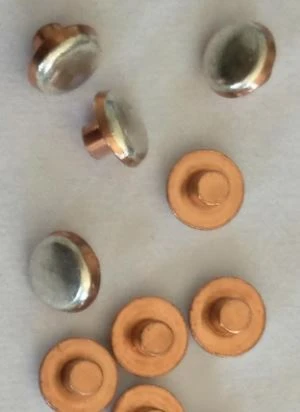
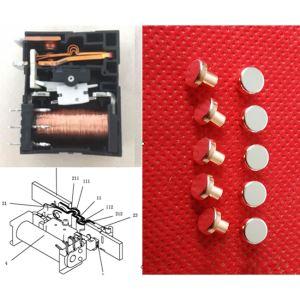
AgNi electrical contacts for relays, switches, contactors, automotive electrical components, and industrial control equipment.
Silver Nickel is a silver-based electrical contact material in which nickel is uniformly dispersed through the silver matrix to increase hardness, wear resistance, and resistance to electrical erosion while retaining high electrical conductivity.
Manufacturing capabilities support AgNi contact materials across different nickel contents and product forms, including AgNi10, AgNi15, and AgNi20, with options for wires, strips, sheets, solid rivets, bimetal rivets, and stamped contact components. Material selection is matched directly to contact geometry, switching duty, electrical load, and manufacturing processes.
AgNi Contact Material Grades
|
Material |
Composition |
Density |
Electrical Conductivity |
Hardness |
Contact Resistance |
|
AgNi10 |
90 percent Ag / 10 percent Ni |
greater than or equal to 10.2 g/cm3 |
greater than or equal to 88 percent IACS |
65 to 90 HV |
less than 1.5 mOhm |
|
AgNi15 |
85 percent Ag / 15 percent Ni |
greater than or equal to 10.1 g/cm3 |
greater than or equal to 82 percent IACS |
75 to 100 HV |
less than 1.8 mOhm |
|
AgNi20 |
80 percent Ag / 20 percent Ni |
greater than or equal to 10.0 g/cm3 |
greater than or equal to 75 percent IACS |
85 to 110 HV |
less than 2.2 mOhm |
Microstructural Advantages and Performance Benefits
The operational reliability of silver-nickel contacts is directly tied to the spatial distribution of the nickel phase within the silver matrix.
Uniform Nickel Dispersion: Controlled powder metallurgy processing ensures that nickel particles are finely and evenly distributed throughout the silver base, preventing localized hot spots and ensuring stable electrical behavior across the entire contact surface.
Anti-Arc Erosion Behavior: While pure silver is prone to material transfer and sticking under frequent make-and-break cycles, the embedded nickel skeleton provides structural rigidity that effectively mitigates arc erosion and mechanical wear in low-to-medium power switching.
Stable Contact Resistance: Low initial contact resistance is maintained over extended operational lifetimes because the silver matrix preserves high electrical conductivity while nickel prevents premature contact deformation.
Thermal and Mechanical Stability: The material retains its mechanical hardness and electrical properties across wide operating temperature variations, making it well-suited for demanding thermal cycles in industrial relays and automotive switching devices.
Material Selection and Application Boundaries
Selecting AgNi10, AgNi15, or AgNi20 requires balancing electrical performance with mechanical wear resistance:
AgNi10: Specified when low contact resistance and high electrical conductivity are primary design parameters.
AgNi15: Provides an intermediate balance between electrical conductivity and mechanical wear properties for general switching applications.
AgNi20: Higher nickel content increases hardness and reduces conductivity relative to lower-nickel grades. Specified where greater resistance to mechanical wear and electrical erosion is required.
Manufacturing and Quality Control
AgNi contacts are produced via powder metallurgy to establish a controlled nickel distribution within the silver matrix.
Production Capabilities: Integrated manufacturing lines cover powder processing, wire drawing, strip rolling, precision stamping, welding, and assembly. Production tolerances include wire tolerance of plus or minus 0.01 mm, strip thickness tolerance of plus or minus 0.02 mm, and rivet-head dimensional tolerance of plus or minus 0.05 mm.
Inspection Protocol: Quality verification covers chemical composition via XRF spectrometry, density, hardness, electrical conductivity and contact resistance, microstructure via metallographic analysis, and critical dimensional checks against approved drawings under ISO 9001 and IATF 16949 standards.
Compliance, Packaging, and Supply Process
Regulatory Compliance: Materials comply with RoHS and REACH standards to meet international export and environmental regulations.
Packaging Standards: Precision contact components are packed in anti-oxidation and moisture-barrier packaging, such as vacuum-sealed layers or specialized carrier tapes, to prevent surface contamination and oxidation during international transit.
OEM Workflow:
Submit technical drawings in 2D or 3D, physical samples, or electrical load specifications.
Engineering review of material grade, tolerance, and carrier structure.
Sample production and functional qualification in customer assemblies.
Mass production release upon sample approval.
Frequently Asked Questions
Q: What is the difference between AgNi10, AgNi15, and AgNi20?
A: The primary difference is the nickel content by weight (10 percent, 15 percent, and 20 percent). Higher nickel content increases hardness and mechanical wear resistance, while lower nickel content provides higher electrical conductivity.
Q: Can custom contact shapes and bimetal rivets be produced?
A: Yes. Custom manufacturing supports solid rivets, bimetal rivets, strips, wires, and stamped profiles based on customer technical drawings, 3D models, or physical samples.
Q: How are finished contacts protected during transit?
A: Contacts are packed using anti-oxidation and moisture-barrier sealing methods designed for delicate precision components to prevent surface tarnish and physical damage during global shipping.
Hot Tags: silver nickel electrical contacts, China silver nickel electrical contacts manufacturers, suppliers, AgSnO2 Material for Low Voltage Switchgear, Environment friendly Materials Silver nickel Alloys, Pure Silver Contact Rivets, Silver Contact Rivets for Contactors, Silver Copper Contact Wire, Silver Nickel Contact Discs