Introduction
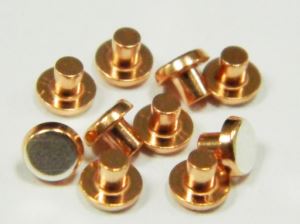
Eco-Friendly Electric Contact Rivets are precision, RoHS-compliant micro-components for low-to-medium voltage applications. Made with heavy-metal-free alloys and sustainable processes, they deliver high conductivity and low resistance while meeting strict global environmental standards.
Technical Specifications & Materials
|
Parameter / Metric |
Specification Details |
Available Options / Values |
|
Base Materials |
Pure Metals & Advanced Alloys |
Ag, AgNi (10-20), AgSnO2 (10-14), AgCuO, Fine-grained Ag, Cu |
|
Layer Configurations |
Structural Types |
Solid, Bimetal (Ag/Cu), Trimetal |
|
Head Diameter (D) |
Precision Range |
1.0 mm - 8.0 mm (Tolerance: +/- 0.05 mm) |
|
Shank Diameter (d) |
Precision Range |
0.8 mm - 5.0 mm (Tolerance: +/- 0.03 mm) |
|
Electrical Conductivity |
Material Dependent |
>= 80% - 100% IACS (International Annealed Copper Standard) |
|
Contact Resistance |
Interface Stability |
<= 2.0 mΩ (Initial) |
|
Hardness (HV) |
Mechanical Strength |
60 HV - 120 HV (Tailored to crimping requirements) |
Technical Features & Performance
100% Heavy-Metal-Free: Formulated without Cadmium (Cd) or Lead (Pb) for full global environmental compliance without sacrificing structural integrity.
High Arc Erosion Resistance: Advanced grain-refinement metallurgy minimizes material transfer, preventing pitting and welding during high-frequency switching.
Optimal Conductivity: Optimized grain boundaries maximize electron flow and minimize localized temperature rise ($\Delta T$) under high loads.
Superior Formability: High-ductility shank design prevents micro-cracking and structural fatigue during high-speed automated riveting.
Long-Term Surface Stability: Anti-oxidation surface treatments prevent tarnishing and contact resistance degradation in humid, harsh environments.
Industrial Applications
Automotive Electronic Control Systems
Engineered to withstand continuous vibration and thermal cycling (e.g., -40°C to +125°C) in low-voltage DC architectures.
Smart Home & Major Domestic Appliances
HVAC Systems: Bimetallic thermostats and Honeywell-type motorized zone valves.
Industrial Automation & Low-Voltage Switchgear
• Motor Control: Primary contact points in magnetic starters and Schneider-type reversing contactors.
• Grid Protection: Mechanism contacts within Miniature Circuit Breakers (MCB) and Siemens-type residual current devices (RCD/GFCI).
OEM / ODM Customization Services
Finite Element Analysis (FEA) and material selection optimization based on your specific current (I) and voltage (V) profiles.
NC-machined sample batches delivered within 7-10 business days for laboratory validation.
Available in specialized tape-and-reel or nitrogen-purged vacuum packaging to integrate directly into your automated vibratory bowl feeders.
Quality Assurance
System Certifications: ISO 9001:2015 (Quality Management), IATF 16949 (Automotive Quality Management).
Environmental Compliance: Full RoHS 3.0, REACH, and Conflict Minerals Free (CMRT) declarations provided with every batch.
Testing Capabilities: In-house SGS-calibrated laboratories utilizing X-ray Fluorescence (XRF) for thickness testing, Microhardness testers, and Scanning Electron Microscopy (SEM) for cross-sectional bonding analysis.
Packaging & Logistics
Protective Packaging
Vacuum-sealed anti-oxidation bags with desiccant in heavy-duty export cartons (max 15kg/carton) to prevent transit tarnish.
Standard Lead Times
14–21 business days from PO confirmation.
Custom Tooling Lead Times
25–30 business days (includes die manufacturing and First Article Inspection/FAI).
Global Logistics
Express air freight (3–5 days to US/EU via DHL/FedEx/UPS) or multimodal sea/air freight for high-volume orders.
Frequently Asked Questions
Q: How do you guarantee the silver layer thickness consistency in bimetal and tri-metal rivets?
A: Our automated co-extrusion and cold-welding machinery utilizes continuous ultrasonic monitoring during production. Additionally, every production lot undergoes cross-sectional metallurgical mounting, polishing, and X-ray Fluorescence (XRF) testing to verify that layer thickness strictly meets the +/- 10% design tolerance specification.
Q: Can your eco-friendly rivets directly replace traditional Silver-Cadmium Oxide (AgCdO) contacts?
A: Yes. Our Silver-Tin Oxide (AgSnO2) and Silver-Nickel (AgNi) alloys are direct, eco-friendly drop-in replacements. They offer comparable or superior anti-welding and arc-erosion performance under AC-1 and AC-15 switching conditions without utilizing hazardous cadmium.
Q: Do you provide full material PPAP documentation for automotive and aerospace buyers?
A: Absolutely. We support rigorous automotive and industrial procurement cycles by providing full PPAP (Production Part Approval Process) Level 3 documentation. This includes IMDS (International Material Data System) registration, Process FMEA, control plans, and formal material test reports.
Q: What measures are taken to ensure the rivets do not oxidize or tarnish during long-term storage?
A: All finished rivets undergo a specialized, chemical-free anti-tarnish surface treatment that protects the contact interface without affecting electrical conductivity. For transit and storage, parts are packed in airtight, nitrogen-purged vacuum bags with active desiccants, guaranteeing a tarnish-free shelf life of up to 12 months.
Q: How do you prevent micro-cracking on the rivet shank during high-speed automated assembly?
A: We control the grain structure of the base copper and silver alloys through precise inline annealing processes. This achieves an optimal hardness profile (typically 60 HV to 120 HV, tailored to your crimping specs), giving the shank the necessary ductility to deform cleanly without micro-cracking under high-speed mechanical riveting stresses.
Q: Are your raw materials fully traceable, and how do you comply with Conflict Minerals regulations?
A: We maintain 100% supply chain traceability. Every batch of rivets is assigned a unique lot number linked directly to the original raw material melt heat number. We strictly source from audited, LBMA-compliant (London Bullion Market Association) refiners and provide full Conflict Minerals Reporting Templates (CMRT) and Extended Minerals Reporting Templates (EMRT) upon request.
Q: What is the minimum contact force required for your eco-friendly alloys to maintain low contact resistance?
A: While the exact force depends on your switch design, our grain-refined AgSnO2 contacts are engineered to maintain a low and stable initial contact resistance (<= 2.0 mΩ) at standard terminal forces starting at 0.5 N to 1.5 N, preventing localized overheating.
Q: Can you manufacture custom-shaped contact rivets, or do you only produce standard round heads?
A: We support full geometric customization. Our advanced multi-station cold-heading equipment can produce specialized geometries, including eccentric shanks, ventilated heads, pointed switching tips, and customized radii designed to optimize localized arc management in complex switchgear.
Hot Tags: environmental friendly electric contact rivet contact, China environmental friendly electric contact rivet contact manufacturers, suppliers, Composite Silver Contact Rivet, Microswitch Contact Contact, Silver Alloy Composite Rivet materials, Silver Nickel Rivet Compound Contacts, Silver Tin Oxide Rivet Compound Contacts, Triplex Rivet Contact